
Your hospital or imaging center needs to connect its RIS and PACS without new servers or months of IT work. Many platforms still require on-premise hardware and custom code every time staff add a site or an AI tool.
By the end of this article you will know which vendor handles cloud scale and zero-footprint viewing, how their API pricing and compliance packages line up, and whether Medicai or Intelerad matches the size and workflow of your group.
Quick Verdict: Intelerad vs Medicai for RIS/PACS Integration
Medicai offers transparent cloud pricing starting at $249 per month with unlimited user accounts and 500 GB storage, while Intelerad maintains enterprise-level pricing that typically requires direct sales consultation.
Deployment models differ significantly between the two platforms. Medicai operates entirely in the cloud through a zero-footprint browser interface. Intelerad installations usually involve multi-week on-premise configuration with dedicated IT resources and infrastructure requirements.
Integration speed follows the same pattern. Medicai connects to existing RIS and PACS systems through standard DICOM and HL7 protocols. Intelerad implementations often require extended configuration periods and custom development work.
Medicai processed over 1M studies in the past year and maintains 1.7M studies in storage across 70 clinics and hospitals. The platform supports 10,000 active doctors and handles 50M yearly API transactions while maintaining HIPAA and GDPR compliance.
Cost structures reflect these deployment differences clearly. Medicai provides fixed monthly pricing with no hidden fees or infrastructure costs. Intelerad pricing models typically include licensing fees, maintenance contracts, and hardware investments that vary by installation scope.
Both platforms support DICOM study routing and EMR integration capabilities. Medicai achieves these functions through cloud architecture that scales automatically without additional hardware procurement or on-site technical staff requirements.
At a glance: how Medicai compares to Intelerad, Medicai for RIS/PACS Integration on the features that matter most.
| Feature | Medicai | Intelerad | Medicai for RIS/PACS Integration |
|---|---|---|---|
| RIS/PACS Integration | ✓ | ✓ | ✓ |
What Is Medicai?
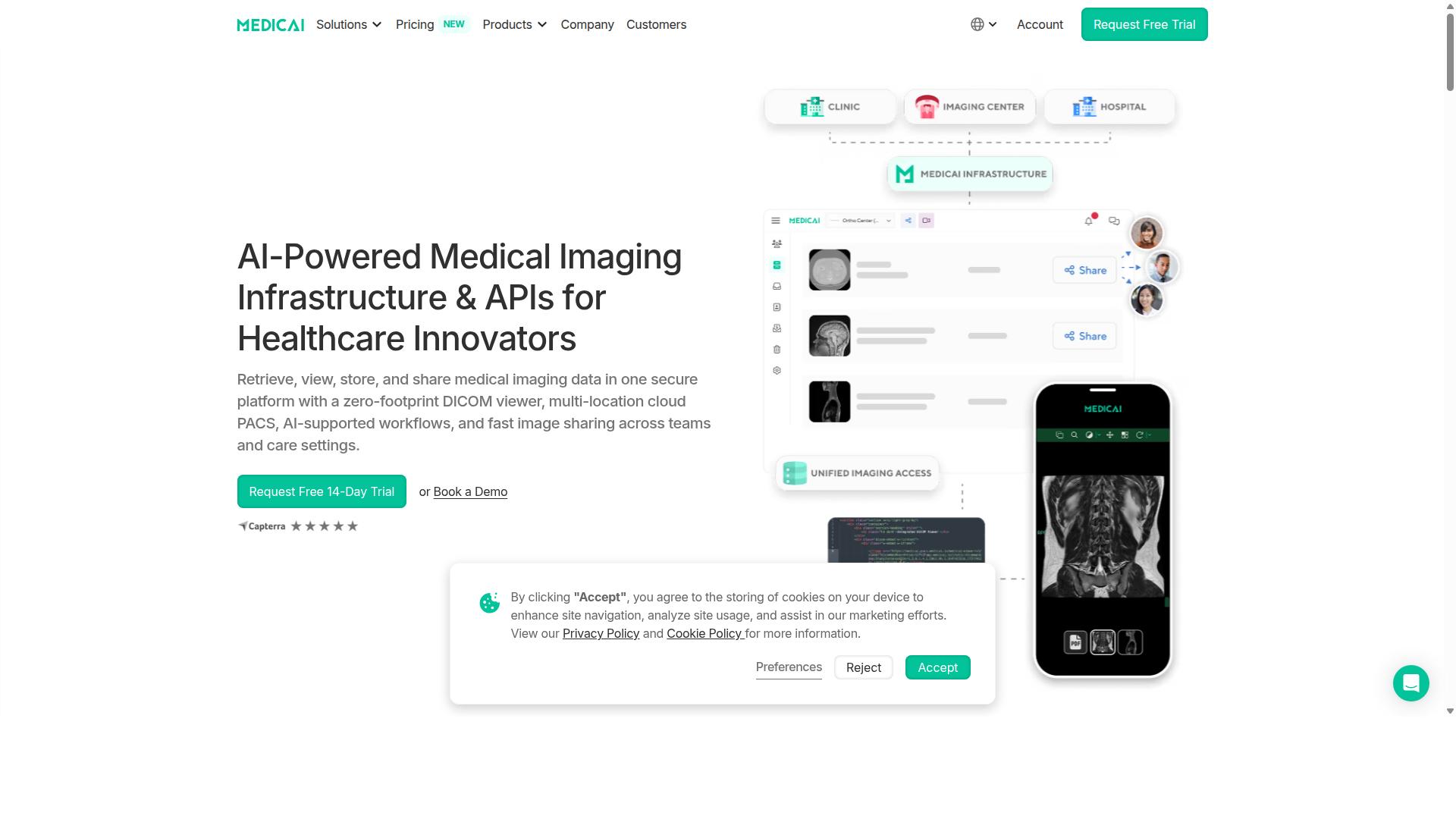
Medicai is a cloud-native medical imaging platform that unifies retrieval, viewing, storage, and sharing of DICOM studies through a single zero-footprint viewer. The platform operates as Imaging Infrastructure as a Service, which removes the need for local software installations and server maintenance.
Its browser-based viewer runs directly in web browsers across different devices. This approach eliminates compatibility issues that often arise with traditional on-premise PACS installations.
The platform maintains HIPAA and GDPR compliance for healthcare data protection. Healthcare providers can access imaging studies without installing additional software at their workstations.
Medicai has processed 1.7 million studies in its cloud storage infrastructure. This demonstrates the platform's capacity to handle substantial imaging volumes across multiple healthcare organizations.
The architecture supports multi-location cloud PACS deployment for facilities operating across different sites. This setup enables consistent access to imaging data regardless of location.
Unlike traditional PACS solutions that require dedicated hardware and local network configurations, Medicai's cloud approach reduces infrastructure management requirements. Healthcare teams can focus on patient care rather than system maintenance.
What Is Intelerad?

Intelerad is a long-established radiology software vendor that supplies on-premise PACS, RIS, and workflow solutions primarily to large hospital networks.
Its traditional product suite centers on enterprise-scale RIS/PACS bundles that run inside hospital data centers.
Many radiology departments rely on these systems to manage medical imaging archives, DICOM studies, and radiology information system tasks across multiple sites.
Deployment models typically involve on-premise PACS servers, local image archives, and tightly coupled reporting modules that require dedicated IT resources.
Integration with existing EMR and EHR platforms occurs through HL7 messaging and custom interface engines.
Some networks also connect external referrers through controlled channels for teleradiology and image sharing between facilities.
Modality connectivity covers most standard radiology equipment, though each new device often needs site-specific configuration.
Study routing and prefetching rules are managed centrally, yet changes can require coordination with vendors and internal teams.
Support for cloud PACS or multi-site access beyond the primary network is limited without additional infrastructure projects.
Organizations evaluating vendor comparison options often weigh these on-premise PACS characteristics against newer deployment models when planning future growth.
What Is Medicai for RIS/PACS Integration?
Medicai provides native HL7/FHIR connectors and documented REST APIs that allow real-time synchronization of patient demographics, orders, and reports between any RIS and its Cloud PACS. Integration endpoints connect directly with hospital systems through standard protocols that maintain compatibility across different vendors.
Study routing rules operate through configurable API parameters. Administrators define conditions based on modality type, patient location, or referring physician to direct incoming studies to specific worklists or storage nodes. Prefetching profiles pull prior exams automatically when new orders arrive, reducing wait times for radiologists who need historical context.
Configuration happens through API calls that set routing criteria and prefetch timing. These rules update without system downtime, allowing radiology departments to adjust workflows as referral patterns change. The platform processes 50 million API transactions annually across connected facilities.
Relevant capabilities include the Medical Imaging Uploader and DICOM Gateway for incoming studies, plus Cloud PACS and Vendor Neutral Archive for storage. Outbound sharing uses the Medical Image Exchange and Patient Case Management tools. Structured Reporting for Radiology and the DICOM Viewer support interpretation while the Doctor Imaging Portal and Patient Imaging Portal provide access points for different user groups.
Additional features such as the Radiology AI Co-Pilot, AI-Powered Diagnostics, and Teleradiology services extend the core integration platform. The system supports Tumor Boards and multi-site access through its Mobile Imaging App and Medicai Imaging API, giving referring physicians and specialists consistent access to imaging data regardless of location.
Features Compared
Three critical dimensions separate the two platforms: deployment flexibility, automation depth, and regulatory certification.
These dimensions matter most when organizations evaluate RIS and PACS integration across multiple sites. The following sections examine each area in detail.
Deployment flexibility determines how quickly facilities can expand without hardware constraints. Automation depth influences how studies move through the radiology workflow. Regulatory certification affects data protection and audit requirements.
Cloud PACS and Multi-Location Access
Medicai's cloud architecture lets any connected facility upload or retrieve studies instantly without VPN tunnels or local servers. Single-tenant Cloud PACS supports unlimited user accounts on the Starter tier and one direct location on the Standard tier. This structure removes the need for site-by-site hardware that typical on-premise PACS demand.
Facilities can add new locations without procuring additional servers or managing local storage. Connect and Retrieve tools include the Medical Imaging Uploader and DICOM Gateway. They enable modality connectivity from any site with internet access.
Intelerad deployments often rely on hardware at each location. Scaling requires new installations and ongoing maintenance cycles. Medicai's cloud model shifts these tasks to the vendor while preserving full DICOM and HL7 interoperability.
Store and Manage services encompass the Cloud PACS, Vendor Neutral Archive, and Backup and Disaster Recovery. These components scale automatically as imaging volumes grow.
AI-Supported Workflows and API Transactions
Over 50 million API calls are processed yearly, enabling real-time AI study pre-annotations and automated routing into partner AI tools such as Rayscape.ai. The Medicai Imaging API triggers AI inference jobs and returns quantitative results directly into the viewer. This open ecosystem approach contrasts with closed AI modules common in legacy RIS/PACS stacks.
Organizations can connect approved third-party algorithms without custom development cycles. Workflow automation covers study routing, prefetching, and structured reporting. These functions reduce manual steps that radiologists and technologists previously handled.
Intelerad solutions typically embed AI capabilities within their own modules. Extending those capabilities requires vendor approval and additional licensing. Medicai keeps the API public, allowing radiology departments to select the AI services they need.
The same API layer supports EMR integration and EHR integration. Patient data and imaging studies flow between systems without duplicate entry.
Security Compliance and Viewer Technology
Medicai's viewer is FDA-cleared and CE-marked, delivering full diagnostic quality at 60 fps without plug-ins while maintaining end-to-end encryption. Security compliance includes HIPAA and GDPR frameworks. The zero-footprint design removes workstation patching cycles and reduces local IT overhead.
Audit-log granularity records each study access event. Compliance teams receive detailed logs for regulatory reviews. OWASP security guidelines guide ongoing platform development.
Intelerad platforms meet standard security requirements yet often need local updates for viewer software. Medicai shifts these responsibilities to the cloud provider. Access, Visualize, Collaborate tools include the Doctor Imaging Portal, Patient Imaging Portal, and Mobile Imaging App. They extend diagnostic access to referring physicians and patients.
Teleradiology workflows benefit from this architecture. Multi-site access and mobile reading become standard features rather than exceptions.
Pricing Compared
Medicai's Starter tier is $249 per month for 500 GB and unlimited users, while Intelerad's licensing is quoted on a perpetual or subscription basis dependent on modality count and site number.
Budget-conscious radiology groups often find the predictable monthly pricing easier to justify than enterprise-level contracts. Medicai's Standard tier at $749 per month expands storage to 2 TB while still including unlimited accounts and one connected location.
Intelerad solutions typically require direct discussions with sales teams to obtain quotes tailored to specific modality counts, site numbers, and perpetual versus subscription models. This approach suits large health systems with dedicated procurement staff but can slow decisions for smaller practices.
Yearly billing reduces Medicai Starter costs to $209 monthly and Standard costs to $639 monthly, delivering a 15 percent savings for organizations comfortable with annual commitments.
Additional locations connect through a one-time $1,000 DICOM Gateway Setup fee per site, keeping expansion costs transparent. Enterprise customers may negotiate per-study pricing when volume justifies custom arrangements.
Intelerad's enterprise positioning generally aligns with hospitals requiring multi-site deployments, custom security policies, and extensive service-level agreements. These capabilities come at price points that reflect full-service implementation and support commitments.
Organizations evaluating RIS and PACS integration must balance upfront costs against long-term scalability. Medicai's published tiers provide clear entry points for practices seeking cloud PACS without lengthy contract negotiations.
Who Should Choose Medicai
Hospitals or imaging groups running three or more locations that need rapid rollout and predictable monthly fees should evaluate Medicai.
Multi-site organizations often struggle with image sharing delays that slow patient care across departments. Medicai offers a cloud PACS solution with verified accessibility for radiology, orthopedics, neurology, and oncology teams that require immediate exchange of imaging studies.
Specialty care providers benefit when imaging moves quickly between sites. Orthopedics practices need swift access to prior studies for surgical planning. Neurology departments rely on fast image transfer to coordinate urgent cases. Oncology teams require consistent image availability for tumor board reviews.
The 300,000+ visualizations per year metric shows production readiness. This volume indicates the platform handles real clinical workloads across multiple specialties without performance degradation.
Cardiology and ophthalmology groups also gain from the same infrastructure. These departments join radiology and other listed specialties in accessing images through the Patient Portal when needed for consultations or follow-up care.
Virtual care providers and teleradiology services fit this profile when they manage distributed reading workflows. The platform supports these use cases alongside traditional hospital systems that require consistent image availability across locations.
Who Should Choose Intelerad
Health systems that already own extensive on-premise infrastructure and require deep customization of RIS workflows may continue to consider Intelerad. These organizations typically maintain dedicated IT teams that handle server management and system updates internally. Such facilities often prefer keeping medical imaging data within their own data centers for compliance or policy reasons.
Academic medical centers frequently operate multiple imaging modalities across research and clinical departments. Their existing IT departments may already support legacy systems that require custom HL7 interfaces or specialized DICOM routing rules. These centers sometimes value complete control over every aspect of their radiology information system configuration.
Integrated delivery networks managing several hospitals under one governance structure may also favor this approach. Their IT teams often handle modality connectivity across different sites and maintain internal security protocols. This model requires significant technical expertise to manage data migration, system updates, and API support for third-party applications.
Organizations with complex reporting module requirements may find on-premise platforms align with their existing EMR integration strategies. These facilities typically need extensive study routing capabilities and custom prefetching rules that their internal teams can modify as needed. The deployment model works best when radiology workflow demands frequent adjustments that only on-site staff can implement quickly.
Who Should Choose Medicai for RIS/PACS Integration
Organizations prioritizing HL7/FHIR synchronization and zero-downtime migrations from legacy archives should shortlist Medicai.
The Medical Image Exchange and Vendor Neutral Archive modules support phased data migration without interrupting existing workflows. Teams can move studies incrementally while the legacy system remains operational and accessible to referring physicians.
These modules work together with multiple vendor platforms through standard DICOM protocols. The approach reduces risk during transition periods and maintains continuous access to patient imaging records across departments.
Medicai transacts one million studies annually across diverse healthcare environments. This volume demonstrates consistent performance with different PACS vendors and radiology information systems during migration projects.
Facilities managing complex vendor transitions benefit from the Cloud PACS foundation that supports both current operations and future growth. The architecture accommodates additional sites without requiring complete system replacements.
Organizations evaluating Intelerad versus Medicai for RIS/PACS integration often find the phased approach addresses concerns about workflow disruption. The combination of Medical Image Exchange capabilities and Vendor Neutral Archive storage provides flexibility during extended transition timelines.
Final Verdict
For cloud scalability, transparent pricing, and immediate API-driven integrations, Medicai is the lower-risk choice. Intelerad remains viable only where deep on-premise customization is non-negotiable.
Medicai processes 1.7 million studies through its cloud infrastructure each year. The platform handles 50 million API calls annually, demonstrating its ability to support high-volume radiology workflows without performance degradation.
Global uptime relies on Microsoft Azure and Amazon AWS infrastructure. This multi-cloud approach reduces single-point failures and supports consistent access across distributed radiology teams.
Organizations evaluating RIS/PACS integration should consider deployment flexibility. Medicai offers cloud-native architecture with API connectivity, while Intelerad requires assessment of on-premise infrastructure commitments.
Proof-of-concept testing allows direct comparison of integration capabilities. Contact Medicai USA at 7901 4th St N, STE 300, St. Petersburg, FL, 33702, or call +1 (832) 220 1035. The Romanian office at 53-55 N Filipescu, 5th Floor, Sector 2, Bucharest, 020961, can be reached at +40 316 305 875. Email inquiries go to [email protected].
Recommended Resources: