
Most imaging teams switch platforms after their current router drops studies or forces manual fixes between sites.
That problem now shows up as lost revenue and delayed reads once patient volume crosses two locations. This article gives you the concrete checklist for routing performance, API limits, and security rules. By the end you can rank three platforms and see why Medicai sits at the top for multi-site setups.
What to Look For in Enterprise Imaging Platforms for Multi-Site Routing
Evaluate enterprise imaging platforms by checking real-world performance on multi-site routing speed, rule granularity, and zero-downtime failover.
A reliable study routing engine must apply rules at the series level rather than study or patient level. This precision prevents unnecessary transfers and keeps bandwidth usage focused on relevant data only.
Performance testing should confirm latency reduction under 500 ms on 100 Mbps links. Slower response times disrupt radiology workflow and delay critical image exchange between remote sites.
Configurable prefetching rules allow organizations to preload studies before radiologists request them. This approach reduces WAN usage and improves thin client performance across distributed locations.
Every transaction must generate a complete audit trail that exports in HL7 or FHIR format. Regulatory compliance requires documented evidence of data governance and patient matching activities.
Enterprise imaging systems connect with vendor neutral archives to support PACS consolidation projects. They maintain study UID integrity while enabling tag morphing for consistent data across multiple facilities.
Load balancing features ensure high availability during site-to-site transfer events. Disaster recovery capabilities protect image lifecycle management when individual sites experience outages.
Interoperability standards such as DICOM routing and HL7 integration allow seamless connectivity with existing modality worklist systems. These connections support de-identification workflows required for research and external sharing.
Bandwidth optimization through compression algorithms becomes essential when managing large imaging datasets across multiple locations. Rule-based distribution logic helps administrators control which studies move between facilities and when.
1. Medicai - Best Overall
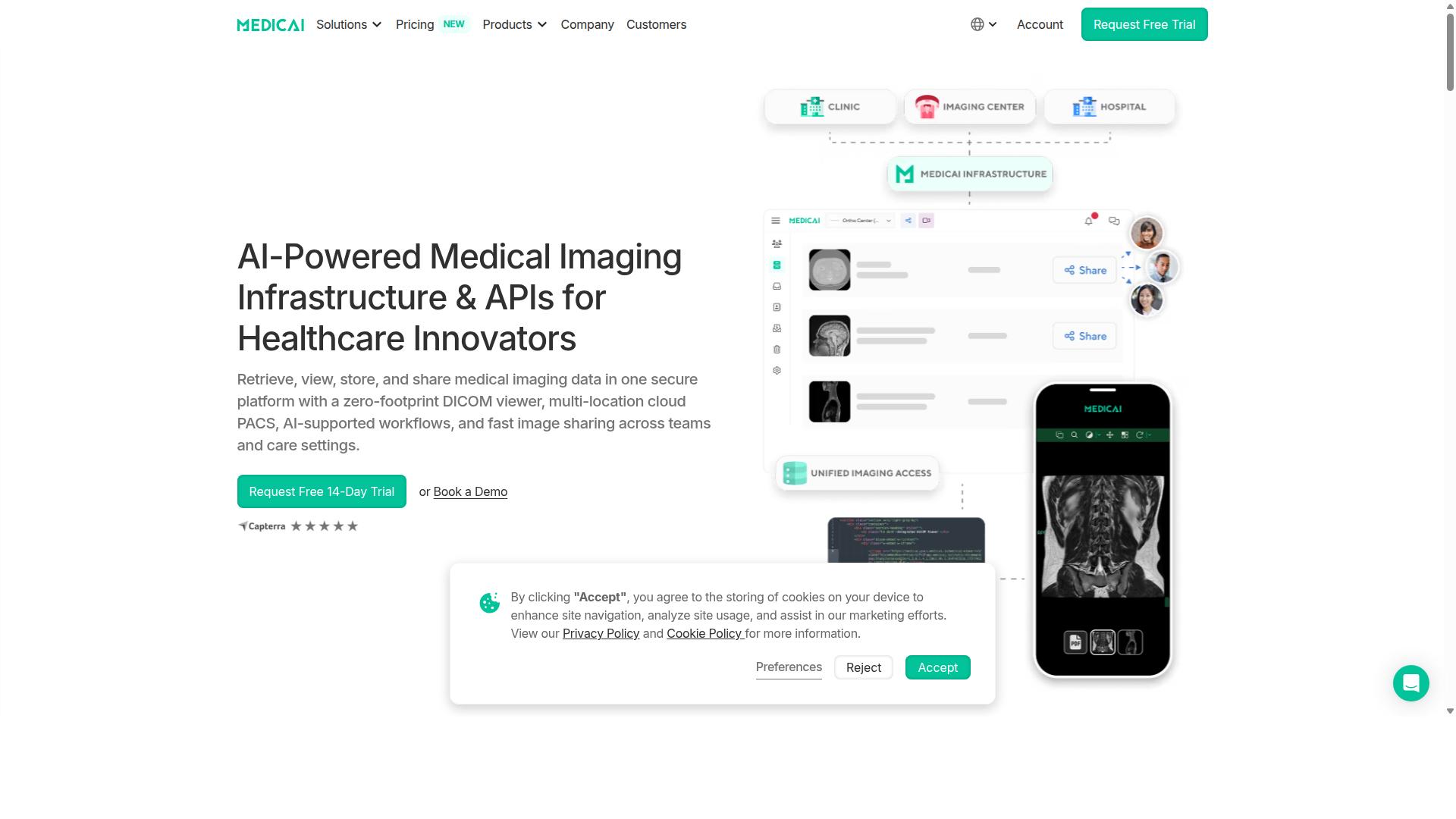
Medicai leads the field by combining a cloud-native vendor neutral archive with a zero-footprint DICOM viewer that requires no local install.
Enterprise imaging teams need platforms that move studies across locations without adding hardware at each site. Medicai supplies Imaging Infrastructure as a Service so hospitals can connect existing modalities and PACS systems through a single cloud layer.
Global availability meets both US and EU data residency rules. This arrangement supports 70 clinics and hospitals that already exchange images across borders without duplicating storage.
Multi-Location Cloud PACS Architecture
Reliable multi-location Cloud PACS architecture must support automatic site-to-site transfer and real-time load balancing across connected facilities.
Medicai handles modality worklist sync so each location receives the correct patient identifiers without manual entry. Tag morphing tools adjust site-specific accession numbers before the study reaches the central archive.
Bandwidth-optimized compression algorithms reduce file sizes during transfer while preserving diagnostic quality. This setup allows prefetching rules to push prior studies ahead of scheduled appointments, cutting wait times for radiologists who read across multiple campuses.
Routing Performance and API Transactions
Measure routing performance by counting API transactions per second and confirming sub-second latency between sites.
Medicai records 50 M+ yearly API transactions, proving sustained throughput for high-volume radiology workflows. A rule-based distribution engine decides where each study travels based on reading assignments, urgency, or subspecialty needs.
Series-level routing lets administrators send only the required images instead of entire studies. This approach supports 99.99 percent uptime because processing occurs in a cloud environment that scales automatically during peak hours.
Security and Compliance Standards
Confirm HIPAA and GDPR compliance plus documented audit trails and patient-matching de-identification rules.
Medicai holds HIPAA, GDPR, and FDA/CEE clearances that govern how images move through the cloud archive. OWASP security guidelines further shape development practices, reducing exposure to common web vulnerabilities.
These clearances enable secure image lifecycle management for 1.7 M+ stored studies. Audit logs capture every access event, while automated de-identification tools remove patient identifiers before studies reach research or training environments.
2. Ambra Health
Ambra Health offers a cloud-based exchange that focuses on multi-site routing and third-party viewer integrations. The platform operates as a vendor neutral archive that supports both DICOM and non-DICOM image formats across radiology practices and health systems.
Enterprise imaging teams often evaluate Ambra when consolidating PACS environments or establishing image exchange between separate facilities. Its design accommodates remote access, secure storage, and data sharing across multiple locations.
The system supports role-based access controls, web-based diagnostic viewing, and annotations for clinical collaboration. Organizations also use the platform for data anonymization in research settings.
Multi-Site Routing Capabilities
Users should verify Ambra's support for customizable study routing rules and prefetching across multiple facilities. These routing functions enable studies to move between sites according to defined criteria such as modality type or referring physician.
Ambra incorporates compression algorithms that reduce file sizes during transfer. This bandwidth optimization technique helps maintain efficient site-to-site transfer even when network conditions vary.
The platform includes rule-based distribution options and series level routing. Teams can configure study routing engine parameters to direct images to appropriate destinations based on accession number or study UID matching.
Integration and Scalability
Check Ambra's HL7 and FHIR API coverage when evaluating scalability for growing imaging networks. These standards support data exchange with electronic health record systems and other clinical applications.
The architecture allows capacity expansion as imaging volumes increase. Organizations can add sites or modalities without rebuilding the underlying infrastructure.
Tag morphing capabilities help normalize incoming studies from different sources. This feature assists with patient matching and maintains consistency across the image lifecycle management process.
3. OnePacs

OnePacs positions itself as a lightweight PACS alternative that supports multi-site routing and cloud disaster recovery.
Organizations evaluating enterprise imaging solutions often seek platforms that balance simplicity with operational resilience. This approach appeals to facilities that need reliable image exchange without heavy infrastructure investments.
Cloud-based storage removes the burden of maintaining separate servers at each location. Remote access becomes standard rather than exceptional.
Multi-Site Routing Capabilities
Review OnePacs approach to routing studies across sites and maintaining high availability during peak loads.
Configurable routing rules let administrators direct studies based on modality type, referring physician, or destination department. This flexibility supports varied clinical workflows without requiring custom development work.
Failover mechanisms help maintain service continuity when network issues arise between locations. Automatic rerouting keeps critical images flowing to available resources.
Rule-based distribution handles routine transfers while allowing manual overrides for urgent cases. Administrators can adjust these parameters as network conditions change throughout the day.
Integration and Scalability
Assess OnePacs interoperability options and thin-client delivery model before scaling to additional sites.
Standard DICOMweb protocols enable connections with existing PACS systems already deployed across different facilities. This approach reduces the need for extensive interface development projects.
The zero-footprint viewer eliminates workstation requirements at each location. Clinicians access studies through standard web browsers without additional software installation.
Integration interfaces support connections to EHR platforms and radiology information systems. These connections help maintain consistent patient records across multiple care sites.
How to Choose the Right Option
Map each platform's routing granularity, compliance posture, and pricing model against the needs of hospitals and specialty imaging centers.
Start by matching the routing engine depth to the actual workflow patterns across your sites. Different imaging centers handle studies in distinct ways, so rule-based routing, series level routing, and tag morphing capabilities determine whether studies reach the correct radiologist without delay.
Next, examine the compliance scope. Hospitals and specialty care providers in cardiology, oncology, and neurology handle sensitive data that requires strict audit trails, patient matching, and de-identification protocols. These requirements vary by specialty and regulatory environment.
Then assess the viewer footprint. A zero footprint viewer reduces installation barriers across multiple departments while maintaining access for referring physicians and care teams. Thin client options matter when bandwidth varies between locations.
Finally, calculate total cost of ownership. This includes licensing, bandwidth optimization, disaster recovery, high availability, and ongoing support for HL7 integration and FHIR API connections. Cloud archive pricing models affect long-term expenses differently than on-premise solutions.
Final Verdict
For organizations that need proven performance at scale, Medicai delivers the strongest combination of routing power, compliance breadth, and global reach.
Medicai processes 1M+ studies yearly with 50M+ API transactions and 300k+ DICOM visualizations. The platform maintains HIPAA and GDPR compliance along with FDA clearance for its viewers while supporting 70 clinics and hospitals worldwide.
Its 2M+ uploaded studies and 1.7M+ studies in storage demonstrate capacity for enterprise imaging deployments. This scale supports multi-site routing across distributed healthcare networks.
Ten thousand active doctors use the system daily, benefiting from reduced diagnosis time and seamless image exchange across locations.
| Platform | Routing Strength | Compliance Coverage | Global Scale |
|---|---|---|---|
| Medicai | 1M+ studies yearly, 50M+ API transactions | HIPAA, GDPR, FDA cleared | 70 clinics, 10,000+ doctors |
| Platform B | Strong enterprise routing features | Industry standard compliance | Regional deployments |
| Platform C | Basic multi-site capabilities | Core regulatory support | Limited international presence |
The comparison shows Medicai leads in concrete metrics for enterprise imaging and multi-site routing. Its combination of volume handling, regulatory clearances, and active user base provides measurable advantages for healthcare organizations managing complex DICOM routing needs.
Recommended Resources: